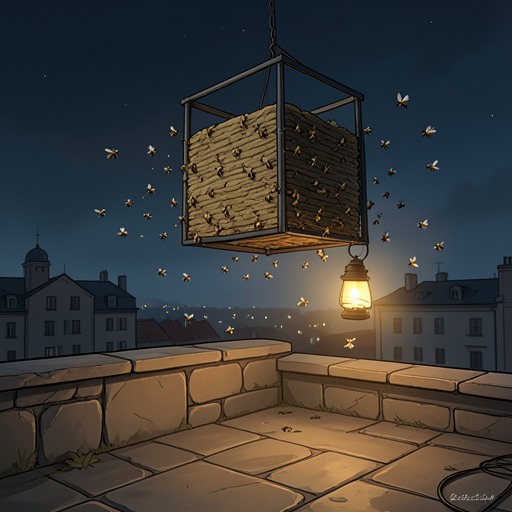
Rooftop honeybee colony
A Gentleman in MoscowThe Rooftop honeybee colony is a working presence above the hotel: its bees travel from the hives to flowering trees and return with honey that carries the flavor of the places they have visited. For Count Alexander Ilyich Rostov, this is more than an explanation of how honey is made. A taste first recalls the lilacs of the Alexander Gardens; a later one brings the distant landscape of Nizhny Novgorod startlingly close. The bees make the roof a meeting point between the hotel and a much wider world.
Rooftop setting and work
The Count first glimpses the bees in the predawn light, above crates that obstruct his view of the Bolshoi Theatre. A whirl of activity gives way to recognition: the movement belongs to bees, and their purpose is practical. Abram explains that they are making honey. Their presence is not ornamental; the roof holds hives, and the bees fly out to forage before returning to them.
Abram introduces the produce with an improvised serving: two slices of black bread spread with honey, laid on a roof tile. The Count accepts a slice. The bread itself surprises him; he cannot readily remember when he last ate it. Its dark rye and molasses provide an earthy, brooding counterpart to the honey’s bright sweetness. The meal is modest, but its ingredients open up a more expansive experience: the flavor of the honey bears a trace of the flowers from which it came.
A map made of flavor
When the Count asks what he is tasting, Abram identifies the lilacs. He points toward the Alexander Gardens, and the flavor restores the Count’s recognition of the place. He recalls knowing those lilacs intimately and spending whole afternoons beneath their white and purple blossoms when they were in season. The honey’s floral note thus connects present taste to a specific, remembered landscape.
Abram also makes clear that the flavor will change. While the lilacs bloom, the bees visit the Alexander Gardens; in a week or so, he says, they will be drawn to the Garden Ring, where the honey will take on the taste of cherry trees. The colony’s range turns seasonal change into something the Count can sample. Flowers bloom in different parts of the city, the bees move between them, and their honey registers those movements without needing a map.
The Count wonders how far the bees will go. Abram answers that some say a bee would cross an ocean for a flower, though he has never known one to do so. The remark sets a limit on the old man’s experience without diminishing the distance the bees can travel. Their ordinary work already reaches beyond the immediate roof and its view of the city.
The return from Nizhny Novgorod
Later, Abram hurries across the roof to show the Count something for himself. Against the brightly lit backdrop of the Bolshoi Theatre, tiny shadows dart above the hives at the hotel’s northeast corner. Abram announces that the bees have returned. He invites the Count to sit, cuts honeycomb from a hive tray with a knife, spreads honey on a spoon, and waits as the Count tastes it.
The Count expects the familiar sweetness to be followed by lilacs from the Alexander Gardens or cherry blossoms from the Garden Ring. Instead, the honey suggests a grassy riverbank, a summer breeze, and a pergola; most unmistakably, it tastes of a thousand apple trees in bloom. Abram names the source as Nizhny Novgorod, and the Count recognizes it. The flavor makes the bees’ journey perceptible: rather than simply carrying a generic sweetness, the honey brings the character of a distant landscape to the roof.
Abram adds, in a whisper, that the bees must have been listening to them all these years. The Count and Abram look toward the roof’s edge, where the bees wheel above their hives after traveling more than a hundred miles. Seen as pinpoints of blackness against the night, they resemble inverted stars. The image gives their industrious return a quiet grandeur, while keeping its scale tied to the concrete facts of flight, distance, and the hives awaiting them.
Significance
The colony makes distance tangible through taste. The lilac honey connects the Count with remembered afternoons in the Alexander Gardens; the later honey carries the sensory signs of Nizhny Novgorod to the hotel roof. These are distinct experiences, one grounded in seasonal foraging within Moscow and the other in the bees’ return from more than a hundred miles away. Together they show how the same sweetness can preserve traces of different places and times.
The bees’ recurrence also gives the roof a life organized by work beyond the Count’s immediate sight. At first he sees only a commotion above the crates; Abram reveals its purpose, then later calls him to witness the return. The colony is both a practical source of honey and a means by which the setting opens outward: the roof is not sealed off from gardens, flowering trees, or distant landscapes, because the bees carry those places back with them.